
How Do Feet Connect into Our Body
If you read my blogs and get my newsletters, you will know I love to share knowledge about the amazing human body.
Of all the things you might have read about here, knowing what you know, what might be the area that feels like it might be often quite neglected by us?
Say, if you have back pain. Often the first thought that occurs would be to to stretch or strengthen your back?
That seems a reasonable step, but often it does not address the issue.
A chiropractic adjustment?
Sometimes, but not always, a helpful step. The problem is that it often comes back so we get reliant on such adjustments.
If that had failed, we are not addressing the root cause of discomfort. It keeps getting triggered, again and again.
Maybe some breathing drills and working on your core?
Also a great step. But it does not fully solve everyone’s issues, either,
Hip mobility?
Now we are getting a bit warmer. Tight, immobile hips that are not used to movement can be a huge contributor to back pain.
How about feet?
Ahhh, now, that is where is starts getting interesting for some of us - if the above approaches had failed.
Most of the time, we hardly even think about our feet. But they are super important.
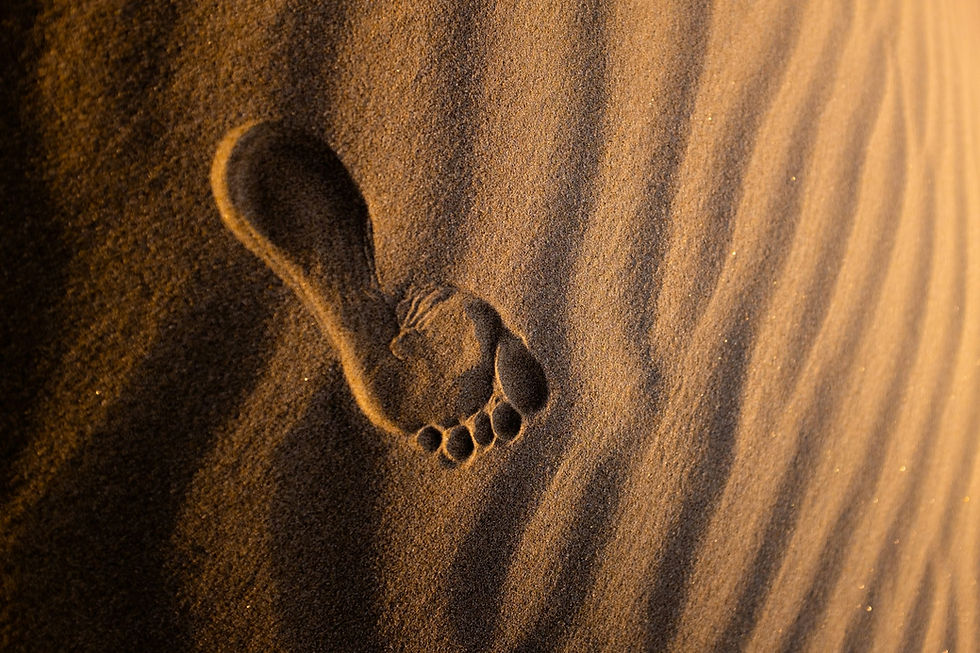
Feet have a direct connection into the pelvic floor, hips and back via deep continuous fascial connections and muscle sheets. These are called myofascial slings.
Think of these as muscle continuums that blend from one to another, creating force transfer as we move. Walking is a hole body movement. Initiation of that movement starts from the push-off point when the big toe leaves the ground behind you.
One such chain of muscles is called the Deep Front line. It starts under the foot, goes up behind the shin bone and inner knee, and into the inner thigh muscles. From there, it sandwiches the hip joint and goes up into the pelvic floor, and also to the front of the pelvis directly into our hip flexors.
So - what if there is an issue with this chain?
Yes, if the inner foot arch collapses and we pronate too much, it creates a downward tug along this entire line, forcing the inner thighs to pull inward, tilting the pelvis, and causing the pelvic floor to become chronically tight, weak, or overcompensated.
This also causes the back to respond - hip flexors become too tight and the back can get over-arched and stiff.
The other key chain is the Superficial Back line. It goes from the underside of the toes, into the Achilles tendon, up the calves and hamstrings, and attaches to the sitting bones. Afterwards, into the sacrum ligaments, the back muscles, and all the way up into the neck (and actually, interestingly, into back of the head muscles - yes, we have some of those up there, too).
What if there is a problem with this line?
Yes, if the foot or calves are stiff, hamstrings are constantly under tension and under-working. Remember, tight muscles are not necessarily strong muscles - they are stuck in a "shortened limbo state"! This will cause the natural lower back curve to flatten and create chronic back pain, compression and pelvic floor tightness.
Each time we take a step, these patterns are reinforced.
So tension in the back is not something to just massage out locally. Hip flexors or hamstrings are not something to just stretch out without reference to what is happening in the pelvic floor and the foot. Hips are not something to force-stretch into rotation without knowing why they are stiff.
The foot can, and does, play a crucial role in all this, too.
The foot is a highly complex mechanical structure that absorbs impact and bears our entire body weight. It is truly amazing - it has 26 bones - a hefty one-quarter of all the bones in the human body!
The foot has three zones:
Hindfoot: Composed of the talus (ankle bone) and the weight-bearing calcaneus (or the heel bone).
Midfoot: A pyramid-like collection of 5 bones which form the foot's arches. They have to move! A stiff midfoot that goes with a very high arch has reduced movement and will struggle to pronate, and not create the right forces up the leg as we walk. Conversely, an overly pronated foot with collapsed arches will have muscles attaching to it not supporting the foot posture, perhaps in over-stretch and certainly weak, so they are also not loading well as we walk.
Forefoot: Contains 5 metatarsals (long bones) and 14 phalanges (toe bones). And many, many muscle attachments!
Each of the toe muscles has muscle connections that, amongst other functions, move them up and down (extensors and flexors), as well as side to side (spreading and narrowing toes).
Problems with these muscles create toe stiffness patterns - hammer toes or bunions amongst many possibilities.

But it is not “just” the lack of movement or “just” stiff or high heel shoes that cause these toe deformities. The way we habitually walk also bears down on our feet, causing these changes to normal toe shape.
It is truly a two-way relationship. The way we use our feet inform how our hips and back feel. The way we use our upper body also creates tension patterns in our feet, causing things like bunions to be created.
Bunions, specifically, are very often created from an improper way we push off with our feet during walking. If the leg if turned inwards as we walk, we push off not through the ball of the foot, but through the edge of the big toe. The body responds by laying on bone to protect the area. The bunion starts to grow.
That is a whole separate subject altogether and one I am really interested in.
You will likely at this stage be wondering as to what can be done about this.
Correction to foot and toes is most often a whole body approach.
Several things I will always assess for, like the following:
We review ankle and hip stability, like - how stable do we feel standing on one leg? Does the hip pop out to the side?
Is there adequate movement in the hip joint itself? this will create tension patterns into the pelvic floor, inner thighs, and many other areas
Is there movement in the foot itself, what is the arch looking like, does the foot pronate and supinate as we walk and as we rotate the torso?
Is there a bunion? when did it get formed, and what are the contributing factors? e.g. was it excessively tight shoes, high heels, or an adaptation that seemingly came out of nowhere? - in which case, it was formed, most likely, from the way we have been walking?
Has there been any injury to the foot, any broken bones, and is there any neurological sensitivity of that area?
Then, depending on the results of the assessment, we devise the right strategy.
It can consist of foot, hip, and core exercises. It might well have some specific stretches for the foot itself, like decompression of the bunion. You might benefit from a big toe straightening device, too.
It will also likely have some neurological assessment of the reflexes around the foot - is the foot over-sensitive to overuse or just normal use around the area?
You will be surprised how important the past injuries will remain even decades after they have been incurred. I see many clients with past ankle sprains or broken toes, and after decades of time, their ankle is still not happy being loaded in the same way as the other one.
So many of these things, if not all, can be addressed even after years have passed, and have a permanent liberating impact on the body.
I usually start by using NeuroKinetic Therapy (R), applied neurology and memory and trauma-releasing approaches to reduce and eliminate the impact of past problems on the body. Once, what I call, “the noise and dust”, have been cleared, the body becomes more tolerant to accept the strengthening exercises.
We can then see what muscle strengthening work needs to be done. So we can layer everything else on top - Pilates reformer, mat, Restore Your Core (R) exercises or rehabilitative drills.
Drop me a line if you would like to find out more, or call on 07768 135481.
To your health
Kaye
#neurokinetictherapy #nkt #foothealth #myofascialslings #foot #feet #posture #alignment #bunion #hammertoe #pronation #supination #arch #walking #pilates #pilatestherapy #corfemullen #wimborne #broadstone #poole #pilatestherapy #kayewoodgate #movebeyond #rehabilitation #strengthening #exercise #restoreyourcore #ryc #pelvicfloor #backpain


Comments