
Breathing Habits, Asthma, and Neck Pain
Breathing... something we take for granted, right?
We rarely think about how we breathe, yet our breathing habits influence everything from posture to the state of the nervous system, and our pain levels. When breathing becomes shallow, strained, or rushed, the neck and upper chest often pay the price.
And if you want your core to be strong, optimising breathing is not a "nice-to-have" - it is totally essential, as it is all deeply interconnected through this important thing called "intra-abdominal pressure management". Management of the pressure created through breathing, 20 to 25 thousand times per day.
Healthy breathing begins in the diaphragm, the broad muscle beneath the rib cage. But when breath becomes shallow—often from stress, poor posture, or long hours at a desk—the diaphragm doesn’t fully expand (and core muscles do not work at all well).
To compensate, the neck and upper-chest muscles step in to lift the ribs with every inhale.
The primary function of these muscles is much more aligned to movement, such as turning the head, but soon the essential (but initially, a secondary) task of helping achieve a deeper breath takes over.
Over time, these small helper muscles become overworked, tight, and tender, leading to the familiar trio: neck pain, headaches, and shoulder stiffness.
I am seeing many people come to my Pilates therapy sessions with a lot of hidden tightness and soreness in the neck. Many complain of their neck making crunching noises, or being more and more stiff as the years go by.
It is not a coincidence. Straight away, we look at breathing patterns, and often discover a very, very sore diaphragm, a stiff ribcage, and pelvic floor problems, to name but a few.
Asthma can amplify this pattern. During flare-ups or even mild restriction, the body instinctively switches to faster, more effortful breathing. The rib cage may feel tight, the diaphragm stiff, and the breath shallow. This reinforces upper-chest breathing and increases tension in the neck and collarbone area. Even when symptoms calm down, the habit of breathing high in the chest may linger.
A tight rib cage limits the diaphragm’s ability to descend fully, so each breath becomes smaller and more effortful. The diaphragm, in turn, can become tight from years of restricted movement. This creates a cycle: limited rib mobility → shallow breathing → neck strain → even tighter breathing patterns.
The good news: breathing habits can change at any age.
Pilates helps by improving rib mobility, strengthening deep core muscles, and teaching coordinated diaphragm activation. Many Pilates exercises intentionally pair movement with slow, full breaths, retraining the body to use the diaphragm instead of the neck.
I often add in specific neck stretches or localised neck muscle massage before we do exercises to calm down overactive neck muscles.
We also do a lot of ribcage mobility and diaphragmatic stretches to help the body rediscover freedom of movement through the torso.
Mindfulness adds the awareness piece. By slowing down and noticing where the breath starts—high in the chest or low in the belly—you can gently redirect it. Mindful breathing reduces stress, softens the rib cage, and gives the diaphragm space to move as it’s meant to. Pilates, certainly the way I like to teach it, gives us that focus.
If you live with neck tension, asthma, or tightness around the ribs, working with your breath can be a powerful place to start. Small, consistent practices help reintroduce ease into the diaphragm, encourage fuller breathing, and lighten the load on your neck.
For your home exploration, why not do this simple exercise?
Build awareness and take stock of where you are now. Lie on your back with your knees bent up and head supported comfortably. Begin by checking in with your breath - does it go high into the collarbones? Into the belly? Is there any side rib expansion? Is there any back rib expansion?
Notice also the state of your inner thought landscape. If you are feeling stressed and your mind is racing, intentionally extending the exhale will help release anxiety, which is highly beneficial for reducing high muscle tone.
Massage. Glide your fingers under the edge of the ribcage at the front and identify any tight spots. Can you hook your fingers right under, or do you feel tension or soreness? Work comfortably on the tense spots for a couple of minutes until there is a drop in tightness. Check if your neck tightnens up during this self-massage exercise.
Release. Go into side-lying, support your head. If you have a Pilates ball, or maybe a tennis ball, you can slowly roll over it side-lying with your ribs being on the ball. Notice any tight spots. Go for what feels pleasant but addresses areas of tension. Then, pause, and breathe into the side of the ribcage that is "up". Notice how you can expand into it. Relax the neck.
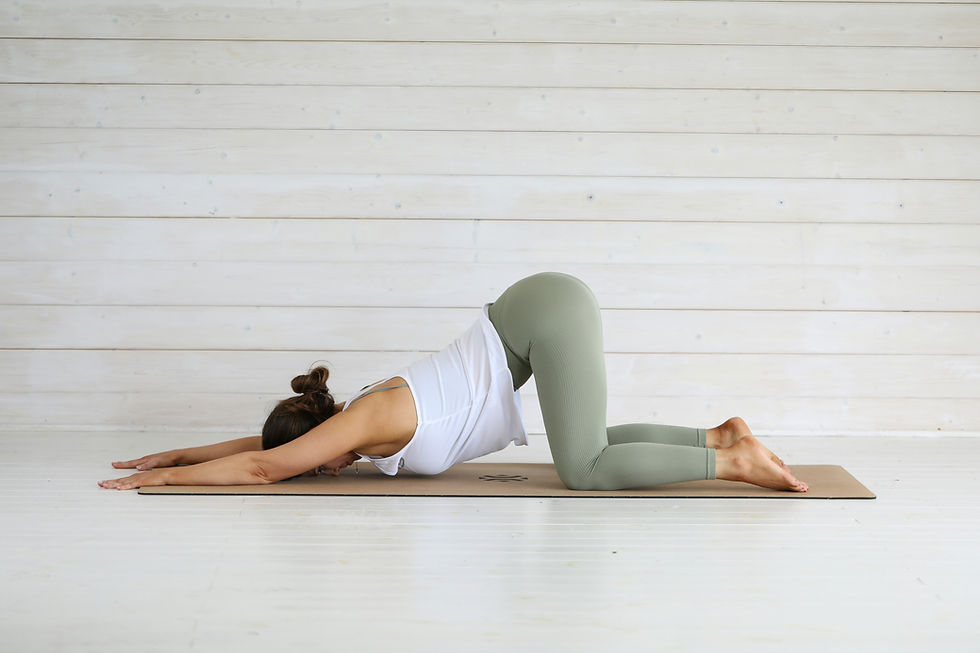
Stand up to rotate. You can do some slow standing, seated or even kneeling twists and side bends. A Pilates exercise "thread the needle" is excellent if you know how to position your arms and shoulders for optimal support. Or, do some standing stretches and rotations. Take it easy if you are new to this. Do this for up to 5 minutes. Doesn't it feel good to move?
Reassess. Return to being on your back and re-check the breathing. Notice how your mind has - hopefully - calmed down.
I hope this is helpful. Do this daily and within a week, you should start feeling the positive benefits.

To your health
Kaye
07768 135481


Comments